

“Justice consists not in being neutral between right and wrong, but in finding out the right and upholding it, wherever found, against the wrong.”
Theodore ROOSEVELT
Overview of O.N.E.
“The Reformer” is a principled type known for their rational and perfectionist nature. They are purposeful individuals and have a basic desire to be good and balanced.
- Strengths: honest, dependable, practical.
- Weaknesses: critical, self-righteous, stubborn.
- Basic Desires: fairness and order.
- Basic Fears: impure motivations and losing control.
Center of Intelligence: Body

Enneagram Ones are located in the Instinctive Center. This means that they have the potential to be grounded and alive in their bodies. Ones filter life experiences through their instincts and use their gut to guide them. They are concerned with justice, seek autonomy, and emotionally struggle with anger. Ones, in particular, try to control their anger so they can control their outcomes.
Adjacent Wings: 1w2 and 1w9
Wings play a major role in expressing type diversity within the Enneagram. Wings can only be adjacent to the dominant type, so an Enneagram One can have a two-wing or a nine-wing based on its position in the Enneagram.
One wing Two
Ones with a Two-wing display principled, interpersonal, and empathetic tendencies. 1w2’s are generally more warm and personal than other Ones. These types want to fight for what’s right and stand up for others in the process. You can often see a 1w2 fighting for social justice and change. Strengths include defending those less privileged, sacrificing their needs for the needs of others, being sensitive, and using their creative ideas to boost an entire group. Weaknesses include overconfidence or even borderline cockiness, being their own harshest critic, and obsessing over the wrong things.
One wing Nine
Ones with a Nine-wing display balanced, strong, and rational tendencies. 1w9’s are usually more calm and steady than other Ones. They do desire justice and can see both sides of an issue very well, making them terrific advocates and optimists. Strengths include being reliable, keeping consistent standards, caring for others, and calmly fighting for what’s right. Weaknesses include being inflexible and stubborn, feeling like they’re not making a big enough difference and criticizing themselves for it, and being (or seeming) too emotionally detached.
Directions of Growth and Stress
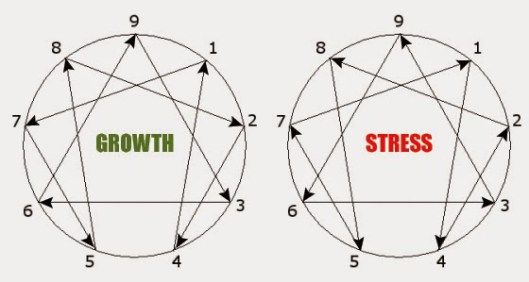
Direction of Growth (Integration)
When an Enneagram One is moving in a direction of personal growth they go toward an Enneagram Seven. This means that they will act more free and embrace joy, they become less critical and more self-accepting, and they assume an optimistic lens.
Direction of Stress (Disintegration)
When an Enneagram One is moving in a direction of stress they go toward an Enneagram Four. This means that they will become more moody and methodical, their inner feeling overflows into their outer environment, and they can become disorderly.
The Stances: Dependent
In times of conflict, Enneagram Ones assume a Dependent Stance (there are three potential conflict stances within the Enneagram). This means that they will refer to other people when they have exhausted their own personal resources. In the Dependent Stance, Enneagram Ones are concerned with the collective good, making connections, and determining what needs to be done to solve the problem.
The Subtypes
The three instincts of the Enneagram, also called the subtypes, are basic instincts present in every human being. Although all three exist in the body, one will be a driving force.
Self-Preservation Ones
Self-Preservation types, in general, are concerned with safety, comfort, and getting their physical needs met. Self-pres Ones tend to be very anxious and the most perfectionist of all the Ones. They view material achievements and physical security as their path to become a good person. They focus on details, have a strong inner critic, and are exceptionally hard on themselves.
Intimate Ones
Intimate types, in general, are concerned with one-on-one connection and depth. Sx Ones tend to be more intense and zealous than other Ones. They are attached to an idealistic view of a “perfect society” and they try to persuade/reform other people into seeing things the way they do. This driving instinct inspires them to share their specific view of things with other people and they may become frustrated when other people resist change.
Social Ones
Social types, in general, are concerned with their social standing and whether or not they are accepted by the tribe. Soc Ones tend to be motivated by fairness more than other Ones. They are systemic thinkers by nature and will often consider how a specific issue will affect the group good. These types are exceptionally welcoming when they’re “at home” with similar ideologies, but they often struggle adapting to new situations or conversations which challenge their beliefs.
 Personality City